
|
|
|
 05-13-2020, 05:13 PM
|
#1 |
|
Practically Lives Here
How Do You Identify?:
Femm Preferred Pronoun?:
She Relationship Status:
**loved by many** 
Join Date: Sep 2012
Location: Closer to the waves
Posts: 15,433
Thanks: 29,188
Thanked 41,035 Times in 10,778 Posts
Rep Power: 21474865   |

My heart goes out to Melissa Etheridge and her family.
A heartbreaking loss. Melissa Etheridge and ex Julie Cypher’s son, Beckett, has died at the age of 21.
__________________
 kisses kissesA kiss is a whisper in your mouth. Can I borrow a kiss? I promise to give it back. |

|

|
| The Following 13 Users Say Thank You to Bèsame* For This Useful Post: |
|
05-18-2020, 12:40 PM
|
#2 |
|
Practically Lives Here
How Do You Identify?:
Femm Preferred Pronoun?:
She Relationship Status:
**loved by many**
Join Date: Sep 2012
Location: Closer to the waves
Posts: 15,433
Thanks: 29,188
Thanked 41,035 Times in 10,778 Posts
Rep Power: 21474865 |
Ken Osmond, best known for his role at the troublemaker Eddie Haskell on the television comedy “Leave It to Beaver,” died on Monday morning. He was 76.
Sources tell Variety Osmond died at his Los Angeles home surrounded by family members. The cause of death is unknown.
__________________
kissesA kiss is a whisper in your mouth. Can I borrow a kiss? I promise to give it back. |
|
|
|
| The Following 8 Users Say Thank You to Bèsame* For This Useful Post: |
|
05-18-2020, 03:19 PM
|
#3 |
|
Senior Member
How Do You Identify?:
Stonebutch Preferred Pronoun?:
she Relationship Status:
single 
Join Date: Jan 2013
Location: Canada
Posts: 3,751
Thanks: 13,371
Thanked 9,434 Times in 3,092 Posts
Rep Power: 21474852 |
RIP
A terrible loss to the Canadian Snowbirds group. SGT> Jennifer Casey died in a crash of her plane yesterday in a flyover to show solidarity across Canada during this virus problem.
Her copilot was injured but will be ok and is resting in hospital. All of Canada loves the Snowbirds and look forward to them each year. RIP Sgt. Casey. |
|
|
|
|
05-18-2020, 04:25 PM
|
#4 |
|
Senior Member
How Do You Identify?:
Stonebutch Preferred Pronoun?:
she Relationship Status:
single
Join Date: Jan 2013
Location: Canada
Posts: 3,751
Thanks: 13,371
Thanked 9,434 Times in 3,092 Posts
Rep Power: 21474852 |
RIP
The above mentioned Snowbird that passed was a Captain not a Sgt.
|
|
|
|
|
05-27-2020, 12:02 PM
|
#5 |
|
Superlative Soul Sister
How Do You Identify?:
Lesbian stone femme Preferred Pronoun?:
She, her Relationship Status:
Moving in a single file and sometimes a sinner. 
Join Date: Dec 2013
Location: Cottage of Content
Posts: 13,732
Thanks: 41,503
Thanked 34,768 Times in 8,976 Posts
Rep Power: 21474861 |
Larry Kramer, Playwright and Outspoken AIDS Activist, Dies at 84
He worked hard to shock the country into dealing with AIDS as a public-health emergency. But his confrontational approach could sometimes overshadow his achievements.
 The author and activist Larry Kramer at an AIDS conference in New York in 1987. In the early 1980s, Mr. Kramer was among the first people to foresee that what had at first caused alarm as a rare form of cancer among gay men would spread worldwide and kill millions of people. Credit...Catherine McGann/Getty Images By Daniel Lewis May 27, 2020 Larry Kramer, the noted writer whose raucous, antagonistic campaign for an all-out response to the AIDS crisis helped shift national health policy in the 1980s and ’90s, died on Wednesday morning in Manhattan. He was 84. His husband, David Webster, said the cause was pneumonia. Mr. Kramer had weathered illness for much of his adult life. Among other things he had been infected with H.I.V., the virus that causes AIDS, contracted liver disease and underwent a successful liver transplant. An author, essayist and playwright — notably hailed for his autobiographical 1985 play, “The Normal Heart” — Mr. Kramer had feet in both the world of letters and the public sphere. In 1981 he was a founder of the Gay Men’s Health Crisis, the first service organization for H.I.V.-positive people, though his fellow directors effectively kicked him out a year later for his aggressive approach. (He returned the compliment by calling them “a sad organization of sissies.”) He was then a founder of a more militant group, Act Up (AIDS Coalition to Unleash Power), whose street actions demanding a speedup in AIDS drugs research and an end to discrimination against gay men and lesbians severely disrupted the operations of government offices, Wall Street and the Roman Catholic hierarchy.  Mr. Kramer at his apartment in Manhattan in 1987. Credit...Ángel Franco/The New York Times “One of America’s most valuable troublemakers,” Susan Sontag called him. Even some of the officials Mr. Kramer accused of “murder” and “genocide” recognized that his outbursts were part of a strategy to shock the country into dealing with AIDS as a public-health emergency. In the early 1980s, he was among the first activists to foresee that what had at first caused alarm as a rare form of cancer among gay men would spread worldwide, like any other sexually transmitted disease, and kill millions of people without regard to sexual orientation. Under the circumstances, he said, “If you write a calm letter and fax it to nobody, it sinks like a brick in the Hudson.”  Demonstrators in front of the New York Stock Exchange in 1989 protesting the high cost of the AIDS drug AZT. The protest was organized by the militant group Act Up, of which Mr. Kramer was a founder. Credit ... Tim Clary/Associated Press The infectious-disease expert Dr. Anthony S. Fauci, longtime director of the National Institute of Allergy and Infectious Diseases, was one who got the message — after Mr. Kramer wrote an open letter published in The San Francisco Examiner in 1988 calling him a killer and “an incompetent idiot.” “Once you got past the rhetoric,” Dr. Fauci said in an interview for this obituary, “you found that Larry Kramer made a lot of sense, and that he had a heart of gold.” Mr. Kramer, he said, had helped him to see how the federal bureaucracy was indeed slowing the search for effective treatments. He credited Mr. Kramer with playing an “essential” role in the development of elaborate drug regimens that could prolong the lives of those infected with H.I.V., and in prompting the Food and Drug Administration to streamline its assessment and approval of certain new drugs. In recent years Mr. Kramer developed a grudging friendship with Dr. Fauci, particularly after Mr. Kramer developed liver disease and underwent the transplant in 2001; Dr. Fauci helped get him into a lifesaving experimental drug trial afterward. Their bond grew stronger this year, when Dr. Fauci became the public face of the White House task force on the coronavirus epidemic, opening him to criticism in some quarters. “We are friends again,” Mr. Kramer said in an email to the reporter John Leland of The New York Times for an article published at the end of March. “I’m feeling sorry for how he’s being treated. I emailed him this, but his one line answer was, ‘Hunker down.’” At his death Mr. Kramer was at work on a play centered on the epidemic. “It’s about gay people having to live through three plagues,” he told Mr. Leland — H.I.V./AIDS, Covid-19 and the decline of the human body, an inevitability brought home to him last year when he fell and broke a leg in his apartment, then lay on the floor for hours waiting for a home attendant to arrive. Master of Provocation Mr. Kramer enjoyed provocation for its own sake — he once introduced Mayor Edward I. Koch of New York to his pet wheaten terrier as the man who was “killing Daddy’s friends” — and this could sometimes overshadow his achievements as an author and social activist. His breakthrough as a writer came with a screen adaptation of D.H. Lawrence’s “Women in Love,” for which he had obtained the film rights with $4,200 of his own money. He also produced the film, which was a box-office hit when it was released in 1969 and a high point of more than one career. The screenplay was nominated for an Academy Award; Glenda Jackson won an Oscar as best actress for her performance; and the director, Ken Russell, established himself as an important filmmaker. Four years later, Mr. Kramer wrote the screenplay for the ill-fated musical remake of the classic 1937 film “Lost Horizon.” Mr. Kramer eventually turned to gay themes, and in his first novel, “Faggots,” he did so with a vengeance. A scathing look at promiscuous sex, drug use, predation and sadomasochism among gay men, it was a lightning rod from the day of its publication in 1978. Some reviewers simply found it beyond belief. (On the contrary, Mr. Kramer responded, it was more a documentary than a work of fiction.) Others complained that it libeled gay people generally, that it lacked literary merit, and that the narrator’s epiphany — one “must have the strength and courage to say no” — was not exactly a stroke of genius. “Faggots” drew a line between Mr. Kramer and a significant number of gay men, who saw him as an old-fashioned moralist or even a hysteric. In various forums well into the 1990s, he found himself called on to defend his point of view, which was essentially that gay men and lesbians had a diminished chance of living fulfilling lives or producing great art so long as they defined themselves primarily in terms of their sexual orientation. He preached not only protected sex but also the virtues of affection, commitment and stability — arguments that anticipated the values of the movement for same-sex marriage. An Uneasy Childhood Laurence David Kramer was born on June 25, 1935, in Bridgeport, Conn., the second son of George and Rea (Wishengrad) Kramer. George Kramer had earned undergraduate and law degrees from Yale University but was unable to make a decent living during the Depression. Rea Kramer supported the family by working in a shoe store and teaching English to immigrants. In 1941, George got a government job in Washington, and the family moved. By his own account, Larry had a miserable childhood and hated his father. His protective older brother, Arthur, was the scholar-athlete of the family, on his way to becoming a prominent lawyer. Larry read the Hollywood gossip columns. “From the day Larry was born until the day my father died, they were antagonists,” Arthur Kramer told Vanity Fair in 1992. Nor were the two brothers always on the easiest terms. In “The Normal Heart,” Arthur Kramer is represented by the character Ben Weeks, a man with ambivalent feelings about his brother’s homosexuality. But they shared an abiding affection until Arthur’s death in 2008. Arthur gave $1 million to Yale in 2001 to establish the Larry Kramer Initiative for Lesbian and Gay Studies, and his law firm became active in pro bono work for causes like same-sex marriage. Larry Kramer himself married his partner, Mr. Webster, in 2013, in a ceremony in the intensive care unit of NYU Langone Medical Center, where Mr. Kramer was recovering from surgery for a bowel obstruction. In 1953, Mr. Kramer, like his father and brother before him, enrolled at Yale. He studied English literature, tried to commit suicide once and had a liberating affair with a male professor. After graduating in 1957 and serving a tour in the Army, he worked in New York, first for the William Morris Agency and then for Columbia Pictures. In 1961, Columbia sent him to London, where he worked as production executive on “Dr. Strangelove” and “Lawrence of Arabia.” He returned to the United States in 1972. He got into AIDS work in the summer of 1981 after reading an article about deadly cases of a rare cancer, Kaposi’s sarcoma, among young gay men. It had previously been associated mostly with older men. A meeting of about 80 people in his New York apartment the next week led to the formation of the Gay Men’s Health Crisis. For the next several years, Mr. Kramer threw himself into fund-raising, lobbying and confrontation, and also into his writing. His landmark essay “1,112 and Counting,” which appeared in the March 14, 1983, issue of The New York Native, was one of many articles taking gay men to task for apathy. ‘The Normal Heart’ The urgency of his life found its way into his plays. “The Normal Heart,” which opened at the Public Theater in April 1985 and ran for nine months, was a passionate account of the early years of AIDS and his campaign to get somebody to do something about it. “The Normal Heart” returned to the stage in 2011, to powerful effect. “By the play’s end,” Ben Brantley of The New York Times wrote in his review, “even people who think they have no patience for polemical theater may find their resistance has melted into tears. No, make that sobs.” That production won the Tony Award for best revival of a play. An HBO adaptation, written by Mr. Kramer, won the 2014 Emmy for outstanding television movie. Less successful was Mr. Kramer’s “Just Say No,” a sendup of official morality aimed at familiar targets, including Ronald and Nancy Reagan. Widely criticized as crude and nasty, it opened Off Broadway in October 1988 and closed a month later. That same year, tests confirmed what Mr. Kramer had long suspected: He was carrying the virus that causes AIDS. “A new fear has now joined my daily repertoire of emotions, and my nighttime ones, too,” he wrote in the afterword to a later edition of his 1989 book, “Reports From the Holocaust: The Making of an AIDS Activist.” “But life has also become exceptionally more precious and, ironically, I am happier.” He turned his attention to another autobiographical play, ultimately titled “The Destiny of Me,” which opened in 1992. Recalling the development of that work in an essay for The Times, he called it “one of those ‘family’-slash-‘memory’ plays I suspect most playwrights feel compelled to try their hand at in a feeble attempt, before it’s too late, to find out what their lives have been all about.” As the play came to life during rehearsals at the Circle Repertory Company, Mr. Kramer wrote, it was a revelation even to him: “The father I’d hated became someone sad to me; and the mother I’d adored became a little less adorable, and no less sad.” He and Mr. Webster, an architect, began living together in 1994, and Mr. Kramer was able to devote much of his time to writing, in spite of being ill for many more years. Believing that he would die soon, he began putting his literary affairs in order. In fact, The Associated Press reported in 2001 that he had died. The real plot twist, though, was that the H.I.V. infection had not progressed; he instead had terminal liver disease, traceable to a hepatitis B infection decades earlier. He underwent the liver transplant in Pittsburgh a few days before Christmas 2001. At the same time, he had been working on a mammoth project, a historical novel called “The American People,” by which he meant the gay American people — a central tenet of which was that many of the country’s historically important figures, including George Washington and Abraham Lincoln, had had homosexual relationships. A first volume, almost 800 pages long, was published in 2015. Volume 2, more than 80 pages longer, was published in 2020. The reviews for “The American People, Volume 1: Search for My Heart” were not kind. Dwight Garner of The Times, for example, called it “a frantic novel that builds up little to no narrative momentum.” “It wasn’t given much serious attention,” Mr. Kramer told The Times in 2017. “Most people seemed to review me, not the book: Loudmouth activist Larry Kramer has written a loudmouth book.” “The American People, Volume 2: The Brutality of Fact,” whose protagonist was based on Mr. Kramer, took its story almost to the present and took scabrous aim at characters clearly based on Ronald Reagan, Hugh Hefner and others. The reviews were not much better. But while Mr. Garner for one found much to dislike, his Times review was not unsympathetic. “It’s a mess, a folly covered in mirrored tiles, but somehow it’s a beautiful and humane one,” he wrote. “I can’t say I liked it. Yet, on a certain level, I loved it.” Looking back in 2017 on his early days as an activist, Mr. Kramer, frail but still impassioned, explained the thinking behind his approach: “I was trying to make people united and angry. I was known as the angriest man in the world, mainly because I discovered that anger got you further than being nice. And when we started to break through in the media, I was better TV than someone who was nice.” Daniel E. Slotnik contributed reporting. https://www.nytimes.com/2020/05/27/u...gtype=Homepage |
|
|
|
| The Following 10 Users Say Thank You to Orema For This Useful Post: |
|
06-04-2020, 09:17 AM
|
#6 |
|
Superlative Soul Sister
How Do You Identify?:
Lesbian stone femme Preferred Pronoun?:
She, her Relationship Status:
Moving in a single file and sometimes a sinner.
Join Date: Dec 2013
Location: Cottage of Content
Posts: 13,732
Thanks: 41,503
Thanked 34,768 Times in 8,976 Posts
Rep Power: 21474861 |
Emma Amos, Painter Who Challenged Racism and Sexism, Dies at 83
Emma Amos, Painter Who Challenged Racism and Sexism, Dies at 83
Early in her career she created brightly colored scenes of black middle-class domestic life. Her later work was increasingly personal and experimental.  The artist Emma Amos with her 2006 work “Head First.” Her paintings often depicted women flying or falling. Credit...Becket Logan By Holland Cotter May 29, 2020 Emma Amos, an acclaimed figurative artist whose high-color paintings of women flying or falling through space were charged with racial and feminist politics, died on May 21 at her home in Bedford, N.H. She was 83. The cause was complications of Alzheimer’s disease, said the Ryan Lee Gallery in Manhattan, which represents her. A key event in Ms. Amos’s career came in 1964. A 27-year-old graduate student in art education at New York University, she was invited to join a newly formed artists group called Spiral. Its members, all African-American, included Charles Alston, Romare Bearden, Norman Lewis and the muralist Hale Woodruff — midcareer artists with substantial reputations. Organized in response to the 1963 March on Washington, the group was formed to discuss and debate the political role of black artists and their work. As an emerging artist seeking exhibition and teaching opportunities, Ms. Amos had already experienced racial exclusion within the larger art world. Now, as the only woman admitted to Spiral, she learned that gender was also a liability to acceptance within the black art community. In an article published in Art Journal in 1999, she recalled that although she felt honored to be part of Spiral, she thought it “fishy” that the group had not asked older, established women artists to join. “I probably seemed less threatening to their egos,” she said, “as I was not yet of much consequence.” The art world, she concluded, was “a man’s scene, black or white.” And she knew that for her, art and activism would be inseparable.  Ms. Amos’s 1966 painting “Baby.”Credit...Emma Amos/Ryan Lee Gallery, New York Emma Veoria Amos was born on March 16, 1937, in Atlanta from a lineage that was, by her own account, “African, Cherokee, Irish, Norwegian and God knows what else.” Her parents, India DeLaine Amos and Miles Green Amos, were cousins. Her father, a graduate of Wilberforce University in Ohio, was a pharmacist; her mother, who had a degree in anthropology from Fisk University in Nashville, managed the family-owned Amos Drug Store. Her parents traveled widely within Atlanta’s black intellectual circles. At home, Ms. Amos and her older brother, Larry, met Zora Neale Hurston and W.E.B. Du Bois. (She would later paint portraits of them standing with her father.) At age 11, she began taking art lessons. She showed notable promise and, as a teenager, had work exhibited at Atlanta University (now part of Clark Atlanta University). In 1954, at 17, she enrolled at Antioch College in Yellow Springs, Ohio, where she majored in art and learned weaving. After graduation and further study in London, she settled in New York City. There she worked for Dorothy Liebes, the innovative textile designer; studied printmaking with the artists Robert Blackburn and Letterio Calapai; and entered graduate school at N.Y.U. Her Spiral invitation came through Mr. Woodruff, who had taught in Atlanta and knew her family. She remained a member until the group disbanded in 1966. By that time, she had completed her graduate degree; married Robert Levine, a writer and early computer consultant; and begun a long teaching career — first at the Newark School of Fine and Industrial Art in New Jersey, then at the Mason Gross School of the Arts at Rutgers University in New Brunswick, N.J., where she remained until retiring in 2008. Skeptical of the overwhelmingly white feminist movement, she held back from involvement in feminist politics until 1984, when the writer Lucy R. Lippard urged her to join the Heresies Collective and contribute to its journal. Heresies was, Ms. Amos wrote in Art Journal, “the group I had always hoped existed: serious, knowledgeable, take-care-of-business feminists giving time to publish the art and writings of women.” She soon joined other feminist groups, including Guerrilla Girls, a collective whose anonymous members appear in public wearing gorilla masks to deliver scathing critiques of art-world racism and sexism. Ms. Amos’s paintings from the 1960s and ’70s often depicted, in bright Pop colors, scenes of black middle-class domestic life, a subject little explored in contemporary art at the time. Her work from the following decades became increasingly personal and formally experimental, combining painting, print media and photographic technology. In the 1992 painting “Equals,” a woman — Ms. Amos herself — is seen floating in free fall against the backdrop of a giant American flag. Replacing the flag’s field of stars is a photographic image of a Southern sharecropper’s shack. The composition is framed in patches of African fabric alternating with printed portraits of Malcolm X. In the symbolic self-portrait “Tightrope” (1994), the artist wears a black painter’s smock over a Wonder Woman costume. Balancing on a tightrope, she holds paintbrushes in one hand and, in the other, a shirt with an image of bare breasts copied from one of Paul Gauguin’s exoticizing images of the Tahitian women he used as models and sexual partners. 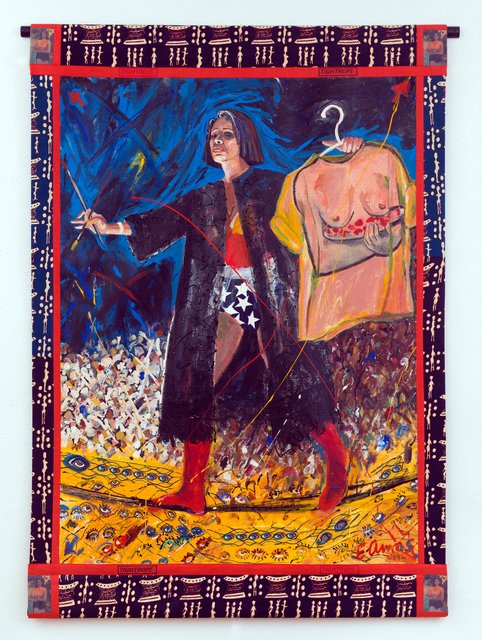 Ms. Amos’s “Tightrope” (1994), a symbolic self-portrait.Credit...via the estate of the artist and Ryan Lee Gallery, New York The startling “Worksuit,” from the same year, is a full-length nude self-portrait in which Ms. Amos depicts herself with a male body. The image of the body was lifted directly from a 1993 nude self-portrait by the artist Lucian Freud. Where Mr. Freud’s figure stands in a bare studio, Ms. Amos places herself in an environment of vertiginously tilting planes and swirling color patterns, as if to suggest that old orders of power and identity — sexual and racial — were shifting and giving way. Although long recognized as an important figure in contemporary American art, and frequently exhibited, Ms. Amos gained mainstream museum notice only within the past few years. In 2017 she was featured in two important surveys: “Soul of a Nation: Art in the Age of Black Power,” organized by the Tate Modern in London, and “We Wanted a Revolution: Black Radical Women, 1965–85,” which originated at the Brooklyn Museum. In 2018, she appeared in “Histórias Afro-Atlânticas” at the Museu de Arte de São Paulo and the Tomie Ohtake Institute in São Paulo, Brazil.  “Will You Forget Me” (1991).Credit...Emma Amos/Ryan Lee Gallery, New York A career retrospective, “Emma Amos: Color Odyssey,” is scheduled to open at the Georgia Museum of Art in Athens, Ga., in 2021, and travel to the Philadelphia Museum of Art and the Munson-Williams-Proctor Arts Institute in Utica, N.Y. Her work is in the collections of several American museums. In 2004 she was given a lifetime achievement award by the Women’s Caucus for Art. Ms. Amos is survived by a daughter, India Amos; a son, Nicholas Amos; two grandchildren; and her brother. Her husband, Mr. Levine, died in 2005. The fact that Ms. Amos’s art complicates, rather than narrows, notions of identity, racial and otherwise, makes it pertinent to the present moment, when binary thinking of all kinds is under scrutiny. At the same time, her careerlong belief in art as a form of ethical resistance carries new weight when the promises of the civil rights era seem again under threat. “It’s always been my contention,” she once said, “that for me, a black woman artist, to walk into the studio is a political act.” Holland Cotter is the co-chief art critic. He writes on a wide range of art, old and new, and he has made extended trips to Africa and China. He was awarded the Pulitzer Prize for Criticism in 2009. https://www.nytimes.com/2020/05/29/a...amos-dead.html |
|
|
|
|
06-19-2020, 09:09 AM
|
#7 |
|
Senior Member
How Do You Identify?:
Cranky Old Poop Preferred Pronoun?:
Mr. Beast Relationship Status:
Married to a beautiful babe whom I don't deserve. Join Date: Nov 2009
Location: Central Texas
Posts: 3,547
Thanks: 11,163
Thanked 9,939 Times in 2,516 Posts
Rep Power: 21474856  |
Ian Holm, the British actor who played Bilbo Baggins in The Lord of the Rings and The Hobbit film productions, has died at age 88.
https://www.cnn.com/2020/06/19/enter...gbr/index.html Apparently, he died peacefully at home today, from a Parkinson's Disease related illness. RIP, Mr. Holm.  ~Theo~ 
__________________
"All that is gold does not glitter, Not all those who wander are lost; The old that is strong does not wither, Deep roots are not reached by the frost." -- J. R. R. Tolkien
|
|
|
|
 |
|
|


 Hybrid Mode
